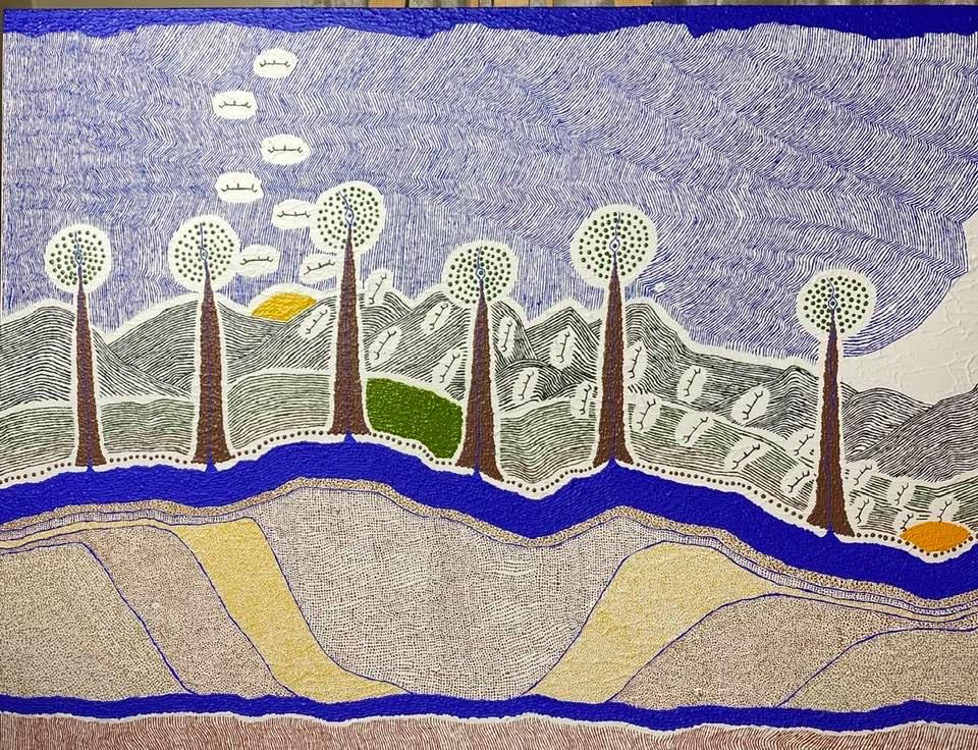
I was in the garden Country Home Mother Cousins Creatures
I was naked
No need for clothes All there were naked Nothing to hide behind
Physically Emotionally Spiritually
All was on show All accepted
Then you saw me for the first time from a distance on the shore
Unlike any other you had witnessed
Naked Exposed Free At ease At home on Country
And you were afraid
Not of me but of yourself
Hidden behind cloth buckles belts boots boats and weapons
Afraid to let me see you as your God made you
So you hid me from view
Courtesy of your afraidness your weapons your power
The power to make me disappear
But not the courage to appear
The Rev Canon Glenn Loughrey, Wiradjuri
Artist, Author, Speaker,Performer.
A/Prof. Crawford School of Public Policy, ANU, Canberra
Canon – Artist in Residence, St Paul’s Cathedral Melbourne
Presentation given at the Bible in Deep Time Symposium, Naarm, 17 October 2024
Introduction
I am grateful for the privilege of joining you today on Wurundjeri Country having travelled in this morning from Bunurong Country where I live. I acknowledge the elders past and present of the Kulin nation and pay my respects to all First Peoples here today, Naomi, Garry, Uncle Ray, Auntie Janet and …. I understand that Jione Havea will join us for lunch. I deeply appreciate the work of the co-organisers of this symposium, Michelle, Naomi and Mick, and the opportunity to collaborate with you all who accepted the invitation to be part of this yarning around Deep Time and the Bible in Deep Time.
I want to share some thoughts about the kind of time I have wondered about from a non-Indigenous perspective as, I hope, one point of conversation with Indigenous readers of the Bible.
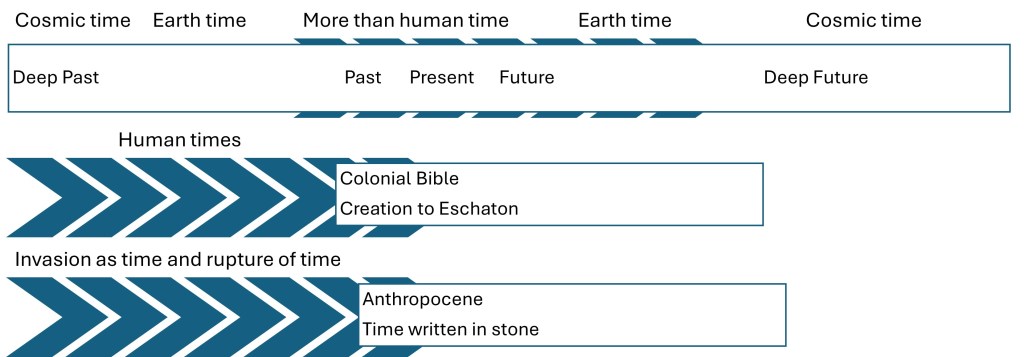
I am interested in a particular instance of the Bible as it arrived in this land as a material artefact of British invasion and colonisation. It seems to me that among other things this arrival can be viewed as both the advent of a kind of linear notion of historical time, and as a rupture of that time.
At the simplest level, time becomes marked by past present future, the before colonisation, invasion, European settlement. There is truth in this, but invasion is not or not only a point in time, a rupture, but an ongoing event that is also described by Chelsea Watego (2021), and others here, as ‘another day in the Colony’. However, the linear thinking of time remains, and in some ways is etched deep in my psyche. This linear thinking characterises a number of ways of describing a Western scientific history of Earth and cosmos that extends in both directions beyond human presence from a Deep Past to a Deep Future, with narratives of cosmology, geology and evolution, for example, telling of a progression through time. A biblical religious narrative of salvation history can be imagined as taking a similar linear path from creation to eschaton, at the individual level from original sin to sanctification – in heaven or on the last day. At the level of bodies, the Western imaginary moves from birth to death even as it is anxious to deny the reality of death.
In this linear framework, what has been called the Anthropocene is seen as another point of rupture. While there is debate about what is the precise point in this linear history at which the Anthropocene begins, the idea is the same: that at some point, the actions of humans as a species — while in reality it is certain groups of over-privileged humans — have changed both the atmosphere of Earth and the geological record, i.e. what is written in stone, so that humans have become an agent at a geological level in a way that was previously unprecedented.
Even this linear thinking of the unfolding of Earth and cosmos offers a way into unsettling the imposition of the Bible as a material artefact of colonisation by seeing and reading it in a much larger context.
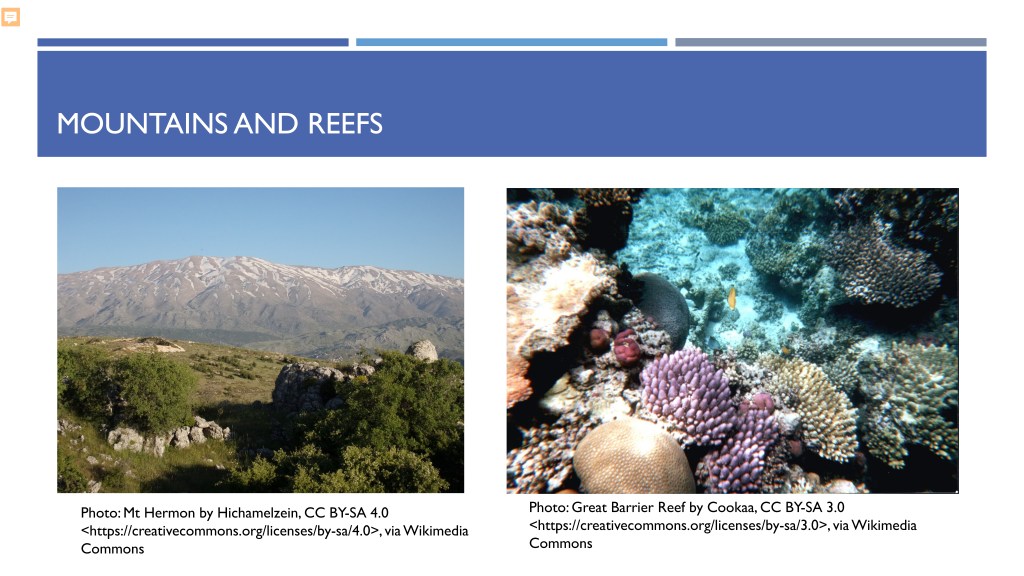
For example, in a reading of the transfiguration in the Gospel of Luke, I think about the sharing of an element: calcium in limestone, mountains and caves, coral, human and other animal bones (Elvey 2023).
Thinking about transfigurations and disfigurations, I wonder about listening to the mountain on which the Lukan Jesus is transfigured, maybe Hermon or another mountain. This transfiguration also holds in it and points ahead to the disfiguration of Jesus in the Roman execution by crucifixion that in turn for Luke holds within it a kind of exodos, liberation.
At the same time, I think about marine scientists and those who listen to them, witnessing the contemporary disfiguration of the Great Barrier Reef due to increased coral bleaching events, the vulnerability of the reef to climate change.
And the kalos, the beauty of the mountains, the reef, the body of Jesus, and so much more.
Holding these together across millennia, through the material element of calcium, that is also in our bones, unsettles a linear way of storying that would separate contemporary trauma and Earth story from ancient ones.
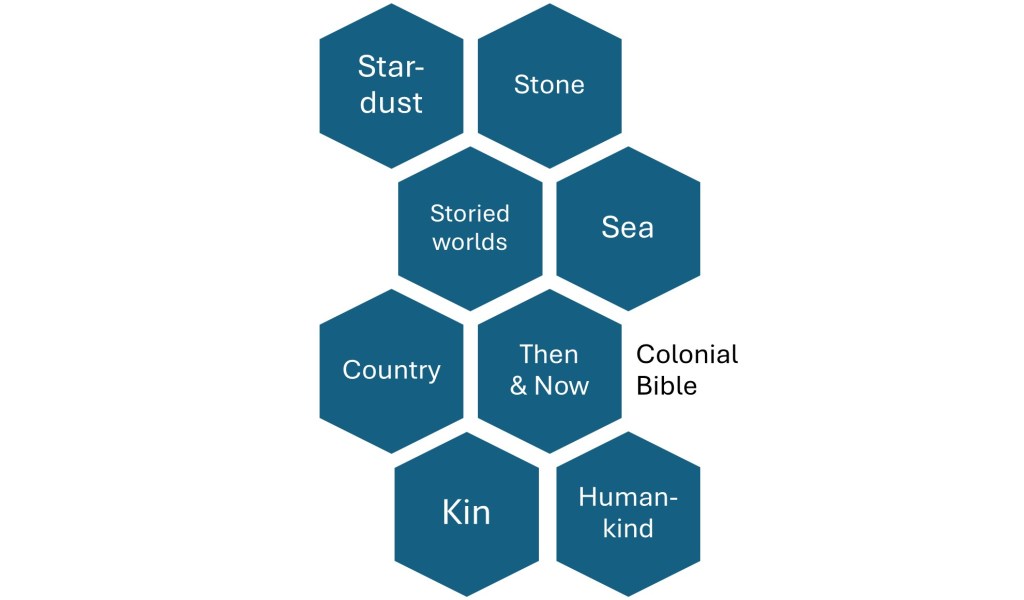
If linear thinking of deep time is insufficient, perhaps there is another way of imagining the connections. Might this honeycomb be another way of imaging deep pasts and deep futures and their contemporary presences.
What is the colonial Bible in this frame? Does it sit outside as a rupture? Yes, but …
It is already interconnected by its very materiality which is not something I oppose in my work to spirituality but talk instead of a material sacred. Spirit and matter deeply entwined, like the way calcium flows through caves, mountains, coral and the bones of humans and other animals.
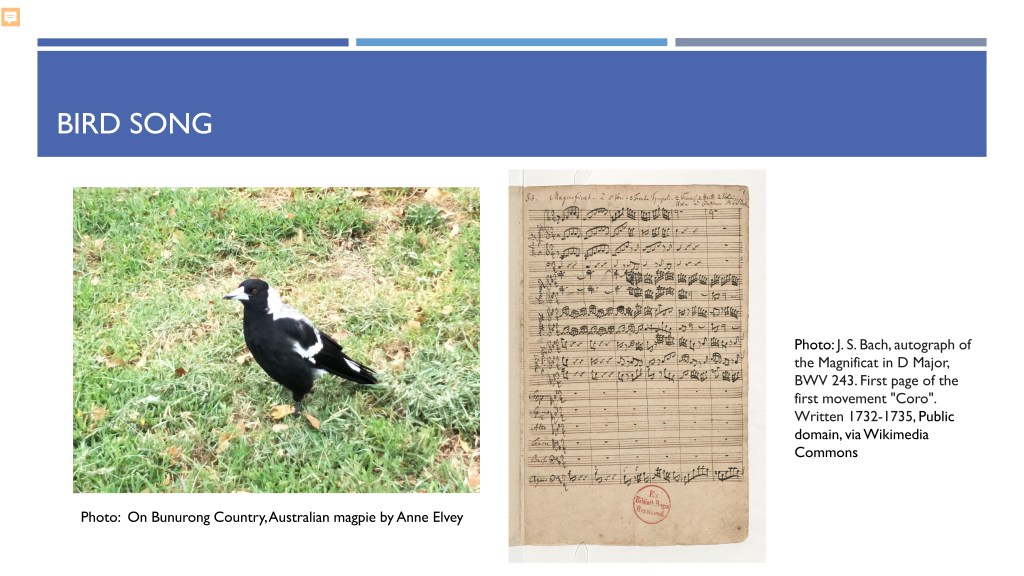
Another attempt I make to think across time is to set a song like Luke’s Magnificat in the context of the story of the emergence of bird song which Tim Low (2014)argues arose in this continent and spread across the globe (Elvey 2020). If human song learns from, echoes, responds to bird song, then the songs that have found their way into the Bible do not arrive disconnected from this place but circle back to the place of their singing avian ancestors.
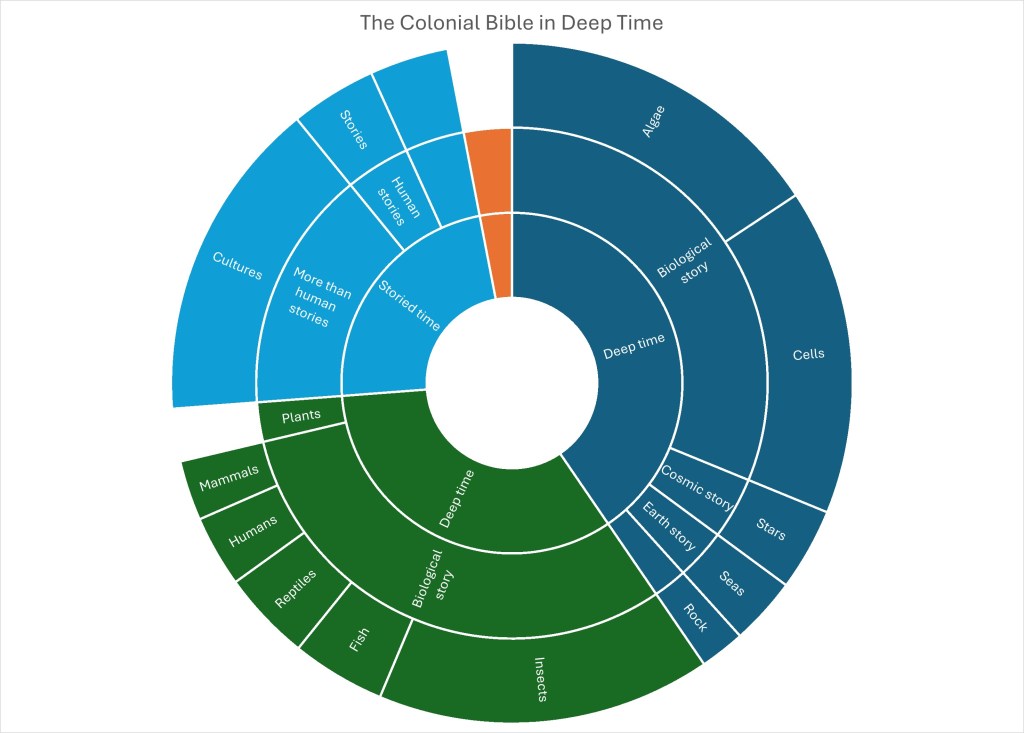
Might deep pasts and deep futures be portrayed as a kind of circle with layers of story, and the colonial Bible as part of this but also an intrusion?
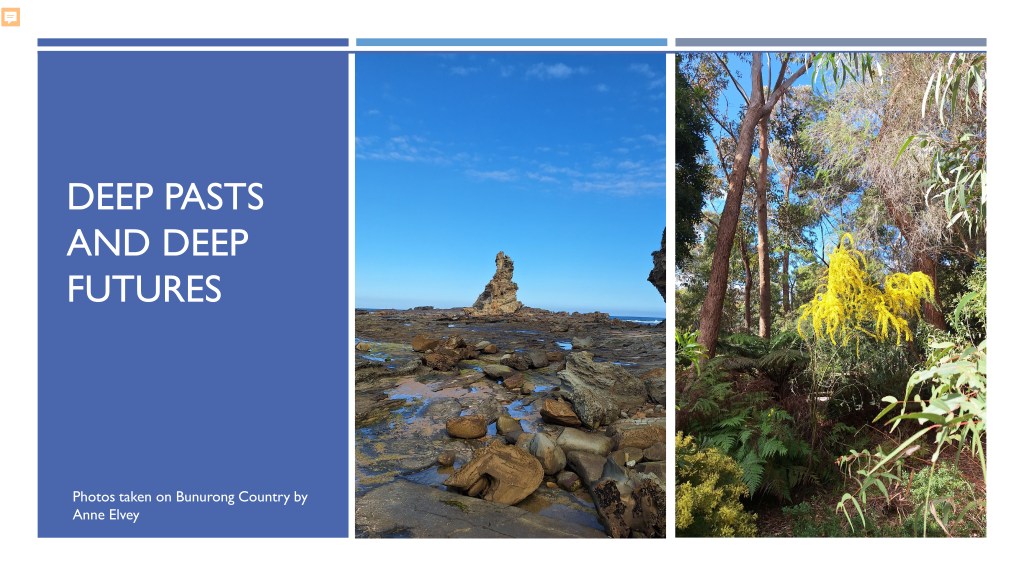
I want to close by reflecting that a deep future is already here in the effects of human actions through climate change and the responsibility this calls forth in us.
According to Tony Birch (2018)and others, this is also part of the colonising same, a colonial déjà vu, an ongoing trauma enacted on Earth, Country and First Peoples, where colonial invasion and ecological trauma intersect. I attempt to address this a little when I consider the signs of the time/season/period or kairos in Luke 12, where recognising the signs of the time – a kind of attentiveness to testimony / truth telling/ truth receiving – is crucial (Elvey 2023).
I hope this short reflection offers some openings for further conversation around colonial time, the Bible and time-space in its depths and breadths …
Anne Elvey
Works cited
Birch, Tony, 2018, ‘”We’ve Seen the End of the World and We Don’t Accept It”: Protection of Indigenous Country and Climate Justice’, in Places of Privilege: Interdisciplinary Perspectives on Identities, Change and Resistance (ed. Nicole Oke, Christopher Sonn and Alison Baker; Leiden: Brill), pp. 139-152
Elvey, Anne, 2020, ‘Deep Time: Mary’s Song and the Songs of Birds’, in Reading the Magnificat in Australia: Unsettling Engagements (Sheffield: Sheffield Phoenix Press), pp. 135-173
Elvey, Anne, 2023, Reading with Earth: Contributions of the New Materialism to an Ecological Feminist Hermeneutics (London: Bloomsbury T&T Clark), esp. chs. 6 & 10
Low, Tim, 2014, Where Song Began: Australia’s Birds and How They Changed the World (Melbourne: Penguin Viking)
Watego, Chelsea, 2021, Another Day in the Colony (St Lucia: UQP)
We’re living in an age where we have more information at our fingertips than ever before. Yet somehow, we’re not necessarily any wiser. Studies show that false news spreads faster and deeper than truth – up to 80% of social media posts may contain inaccurate information. The problem? What’s most visible feels most real, and what we see most often becomes what we believe. This is the availability heuristic at work – our tendency to make judgements based on whatever information is easiest to recall. You’re actually experiencing it right now as you read these words. In a split second, you’re reading, interpreting, linking to what you already know, inferring meaning, and reading on.
But here’s where it gets interesting: the availability heuristic isn’t just about how we remember – it’s deeply shaped by what we have available to remember in the first place. And that depends entirely on the breadth of our knowledge pool.
For most of us raised in Western systems, that knowledge pool can often look fairly specific. It may be topic-based, academic, requiring traditional pathways of learning and rigorous critique. It can be expert knowledge, professional knowledge, field-specific knowledge. And whilst there’s absolutely nothing wrong with this kind of knowing, it’s not the only kind.
There’s other ways of knowing that are more than just a topic or field of speciality – entire ways of Knowing, Being, and Doing. Indigenous Knowledge systems around the world encode understanding through Place, Story, Song, Ceremony, and Embodied practice. This isn’t romantic nostalgia; it’s sophisticated epistemology that has maintained accurate memory and knowledge across tens of thousands of years. Consider this: Specific to Place – some Aboriginal Peoples through complex oral traditions, document sea level changes from over 7,000 years ago with remarkable accuracy. That’s not because someone wrote it down in a book – it’s because Knowledge was encoded through relationship with Country, passed down through Ceremony and Story, held within dynamic, reciprocal relationships between all Living things.
What does this have to do with faith and spirituality? Everything. Institutional religion, particularly in the West, has often collapsed into the same narrow framework. We’ve reduced rich, embodied spiritual wisdom into simplified doctrines, bullet points, and information to be consumed. We’ve privileged certainty over mystery, answers over questions, individual belief over communal relationship.
But what if we asked a different question? Not “what do I know?” but “what kind of knowledge am I drawing from?”
This isn’t about abandoning one form of knowledge for another. It’s about recognising that different kinds of knowledge work in different ways, and we need the breadth to draw from multiple sources. It’s about expanding what’s available to us so that when our heuristics kick in – and they will – we’re recalling from a deeper, richer, more interconnected pool of understanding.
The power of critique isn’t in tearing down; it’s in transformation. It’s in being willing to ask: where are the deficits? Where are the gaps in my current knowledge? What am I missing because I’ve only learnt to see in one particular way?
Because ultimately, what we remember shapes what we believe. And what we believe shapes how we live.
Perhaps it’s time to expand what’s available.
James is a deep thinker exploring how Indigenous Knowledge, neuroscience, and spiritual practice intersect. Currently completing a Bachelor of Psychological Science at Southern Cross University, his research interests include relational epistemology, embodied cognition, and how understanding human behaviour and dynamics can better equip faith communities to support people authentically. A professional consultant in construction, building physics and material science, James brings practical business management and leadership experience to philosophical inquiry about memory, knowledge systems, and transformative change.
Today I want to offer an introduction to the concept of deep time from a western scientific perspective, together with some brief reflections on biblical texts. I anticipate that this will leave room for later discussions on non-western perspectives on both topics. I will discuss three areas: deep time and biblical creation stories, deep future and biblical eschatology, and deep present, where history and geology collide.
Deep past
The prompts for a discussion on deep time are many, however my concern is linked to the so-called Anthropocene, of which I will have more to say later.
Noah Heringman defines deep time as marking
the incommensurability between geological and historical time scales, between the earth’s gradual changes over hundreds of millions of years and the rapid changes occurring in even a century of human history.
Such a definition takes for granted uniformitarianism, which emphasises that geological forces act slowly over very long-time scales. This view was first advanced by geologist Charels Lyell and James Hutton. Hutton no doubt found this view compatible with his Newtonian style Deism. The alternative view is the catastrophism of George Cuvier and others, with roots are in 17th century attempts to explain biblical events like the Flood using natural processes.
When read in a literalistic manner, the Priestly creation story collapses 4.5 billion years into six days. In its historical setting, Gen 1:1 – 2:3 likely takes its final form in the post-exilic period. It pictures creation as a protological temple and provides an aetiological account of the Sabbath. As such, it is written to post-exilic, second temple religious life.
A better approach is to understand the text stretching the history of Israel over Earth history. The creator is not merely Israel’s Yahweh (let alone Babylon’s Marduk) or Abraham’s El Shaddai, but the more general Elohim. If the God is not limited in scope or concern with the people of Israel, why limit that God to any one people, species, or geological period?
a narrative of many dispersed and networked actors, none acting with the sense of internal autonomy with which humanist historians suffuse the word ‘agency’.
Yet now we see human agency likewise as dispersed, and often acting without autonomy. Agency is limited by capitalist society to consumer choice, while key actors refuse to act out of self-interest. As the Anthropocene finds its origins in settler colonialist, and Helen Davis and Zoe Todd have stressed, the reduction or removal of autonomy of the many is a central feature of capitalism.
The deep present announces the return of catastrophism in that geological history and human history now have a shared vocabulary. Physicist Carl Sagan describes nuclear winter in terms of the asteroid that “killed off the dinosaurs,” while geologist Walter Alvarez describe the asteroid impact in terms of atomic bombs. We are now both dinosaur and asteroid. The asteroid of climate change is slower and more prolonged than nuclear war, but no less devastating if left unabated.
It is here that the deep time perspective of the Priestly tradition comes to the fore. Chaos is introduced by human overreach. In the light of the exile into Babylon, Israel could reflect on the excesses of the monarchy. As Michael Northcott observes that
From the Sabbath law the Hebrews adumbrated a range of related laws in the Deuteronomic code which moralised the material activities of agrarianism.
This moralising of agrarianism is also found in the Priestly tradition, as is seen by the Sabbath rights of the land. Creation has a divinely given agency (Gen 1), and the land embodies and carries out divine justice. In Lev 18, the defilements of the people of the Land are transferred to the land, and hence God visits judgement on it. In turn, the land vomits out those that defile it. The blessings pronounced in Gen 2 of trees bearing fruit and a peaceful relationship with the creatures of the land is overturned in Lev 26.
In this context, Sabbath is a recognition of the circularity of time, from harvest to harvest. Past chaos ever threatens to upend the good order of a regular climate and agricultural yield. While chaos needs understood more broadly (see Catherine Keller), here it is a consequence of human disobedience, which is to be kept at bay. The principles of Sabbath and Jubilee work together with a keeping of the soil (Gen 2:15), which Ellen Davis notes means learning from its wisdom.
Deep future
Given the shortness of a human life, let alone social media or political cycles, it is little wonder that we struggle with the concept of deep future. Physical eschatology describes long term astrophysical changes. The sun is roughly halfway through its time on the main sequence, after which it will become a red giant and boil away the Earth’s atmosphere and oceans.
On unimaginable timescales, the universe will continue to expand, eventually facing the heat death. While considerations of this go well beyond today’s discussion, I find unsatisfactory the approach of C S Lewis’ approach in The Weight of Glory where he states that
Nature is mortal; we shall outlive her. When all the suns and nebulae have passed away, each one of you will still be alive. Nature is only the image, the symbol.
In the shorter term, the most pessimistic climate change scenarios could render the earth uninhabitable for human beings in centuries. Typically, climate change scenarios run to the end of the century, Tim Lenton (unironically) refers to this as the political time horizon, because it is within the lifetime of our grandchildren.
Longer term thinking is required, and his ethical time horizon is of order 1000 years, because he claims that this is the lifetime of civilisations. We might well challenge this assertion given that the world’s oldest continuous culture may have existed for a third of the time our species has been on the planet. The point is that humans need to think well beyond the present.
So, given the possibility of our self-annihilation, let alone the unfolding of otherwise uninterrupted physical processes, what does it mean to speak of humanity as the image of God? What does deep history have in common with biblical eschatology? Scripture is not unaware of human insignificance. Psalm 8 reflects upon this when considering the stars. From a modern scientific perspective, we know that the vastness of space is related to the enormity of time.
In terms of biblical eschatology and deep future? Firstly, while I think it is true that the present is incomparable to the long-term future, and that cosmology is not the final story, the deep future is also deeply present. Eden is the eschatological horizon, and hence biblical eschatology has a definite “back to the future” orientation.
Ezekiel 36:35 describes the restoration of the nation to the status of Eden, as does Isa 51:3. Revelation, I believe is best read to describe the present state of the church – although not without remainder. Hence eschatology demands of peace and justice are firmly in the present, yet incomplete.
Deep engagement
The challenges of deep time for Scripture and engagement with the Anthropocene and alternative epistemologies is not insurmountable. The Bible has its own understanding of deep time, which is not simply linear like Western ideas of progress, but somewhat cyclical. Such a view must be allowed to sit alongside the sciences, for no one narrative either informs our understanding of the way the world works, or how we are to respond to the needs of the present.
Mick Pope is a meteorologist and theologian. Mick is working in the area of panentheism and a theology of mass extinction and ecocide.
If you would like to contribute to this project or be added to our mailing list, please get in contact with us.
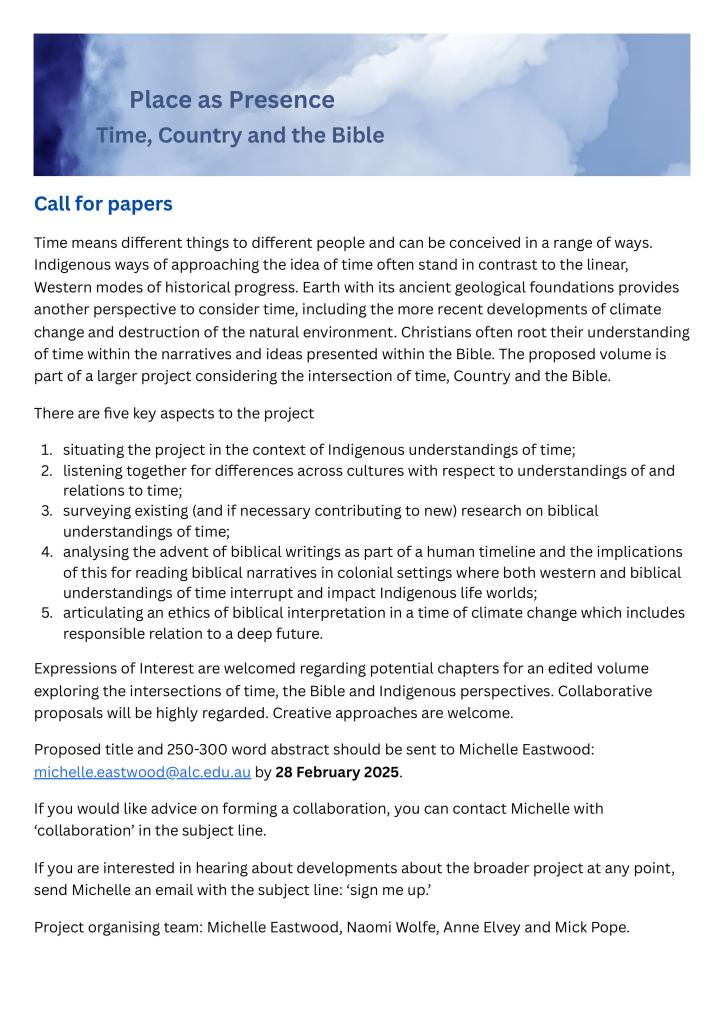
Expressions of Interest are welcomed regarding potential chapters for an edited volume exploring the intersections of time, the Bible and Indigenous perspectives. Collaborative proposals will be highly regarded. Creative approaches are welcome.
Proposed title and 250-300 word abstract should be sent to us by 28 February 2025. .
Please contact us if you are interested in a collaboration or if you would like to be joined up for the mailing list.


 Place is Presence: Time Country Bible