
Earth-Time Disruptions of the Colonial Bible
Presentation given at the Bible in Deep Time Symposium,
Naarm, 17 October 2024
Introduction
I am grateful for the privilege of joining you today on Wurundjeri Country having travelled in this morning from Bunurong Country where I live. I acknowledge the elders past and present of the Kulin nation and pay my respects to all First Peoples here today, Naomi, Garry, Uncle Ray, Auntie Janet and …. I understand that Jione Havea will join us for lunch. I deeply appreciate the work of the co-organisers of this symposium, Michelle, Naomi and Mick, and the opportunity to collaborate with you all who accepted the invitation to be part of this yarning around Deep Time and the Bible in Deep Time.
I want to share some thoughts about the kind of time I have wondered about from a non-Indigenous perspective as, I hope, one point of conversation with Indigenous readers of the Bible.
I am interested in a particular instance of the Bible as it arrived in this land as a material artefact of British invasion and colonisation. It seems to me that among other things this arrival can be viewed as both the advent of a kind of linear notion of historical time, and as a rupture of that time.
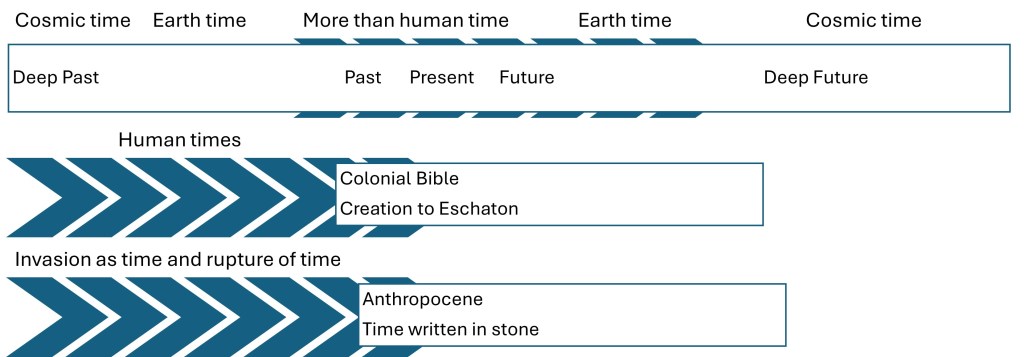
At the simplest level, time becomes marked by past present future, the before colonisation, invasion, European settlement. There is truth in this, but invasion is not or not only a point in time, a rupture, but an ongoing event that is also described by Chelsea Watego (2021), and others here, as ‘another day in the Colony’. However, the linear thinking of time remains, and in some ways is etched deep in my psyche. This linear thinking characterises a number of ways of describing a Western scientific history of Earth and cosmos that extends in both directions beyond human presence from a Deep Past to a Deep Future, with narratives of cosmology, geology and evolution, for example, telling of a progression through time. A biblical religious narrative of salvation history can be imagined as taking a similar linear path from creation to eschaton, at the individual level from original sin to sanctification – in heaven or on the last day. At the level of bodies, the Western imaginary moves from birth to death even as it is anxious to deny the reality of death.
In this linear framework, what has been called the Anthropocene is seen as another point of rupture. While there is debate about what is the precise point in this linear history at which the Anthropocene begins, the idea is the same: that at some point, the actions of humans as a species — while in reality it is certain groups of over-privileged humans — have changed both the atmosphere of Earth and the geological record, i.e. what is written in stone, so that humans have become an agent at a geological level in a way that was previously unprecedented.
Even this linear thinking of the unfolding of Earth and cosmos offers a way into unsettling the imposition of the Bible as a material artefact of colonisation by seeing and reading it in a much larger context.
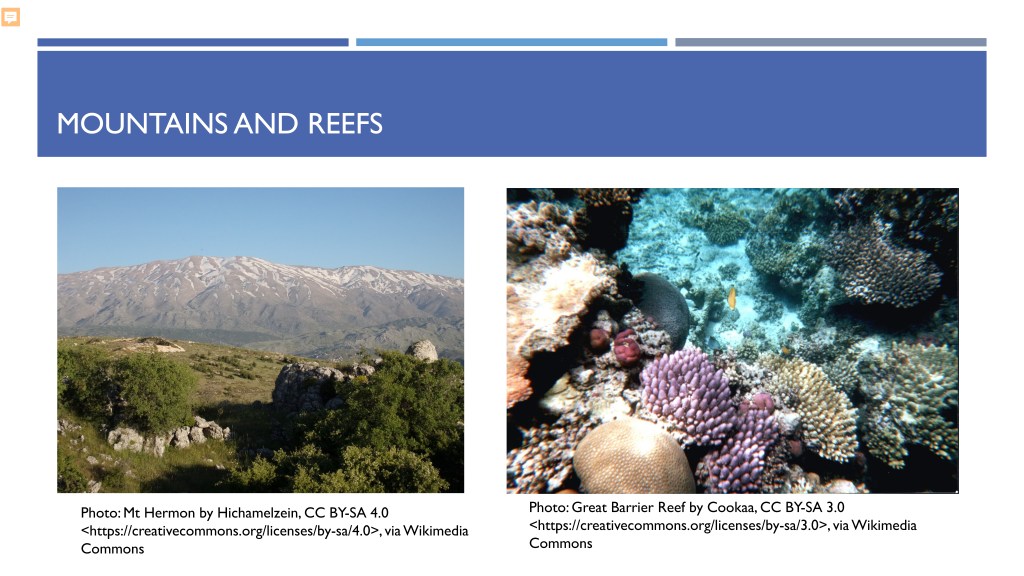
For example, in a reading of the transfiguration in the Gospel of Luke, I think about the sharing of an element: calcium in limestone, mountains and caves, coral, human and other animal bones (Elvey 2023).
Thinking about transfigurations and disfigurations, I wonder about listening to the mountain on which the Lukan Jesus is transfigured, maybe Hermon or another mountain. This transfiguration also holds in it and points ahead to the disfiguration of Jesus in the Roman execution by crucifixion that in turn for Luke holds within it a kind of exodos, liberation.
At the same time, I think about marine scientists and those who listen to them, witnessing the contemporary disfiguration of the Great Barrier Reef due to increased coral bleaching events, the vulnerability of the reef to climate change.
And the kalos, the beauty of the mountains, the reef, the body of Jesus, and so much more.
Holding these together across millennia, through the material element of calcium, that is also in our bones, unsettles a linear way of storying that would separate contemporary trauma and Earth story from ancient ones.
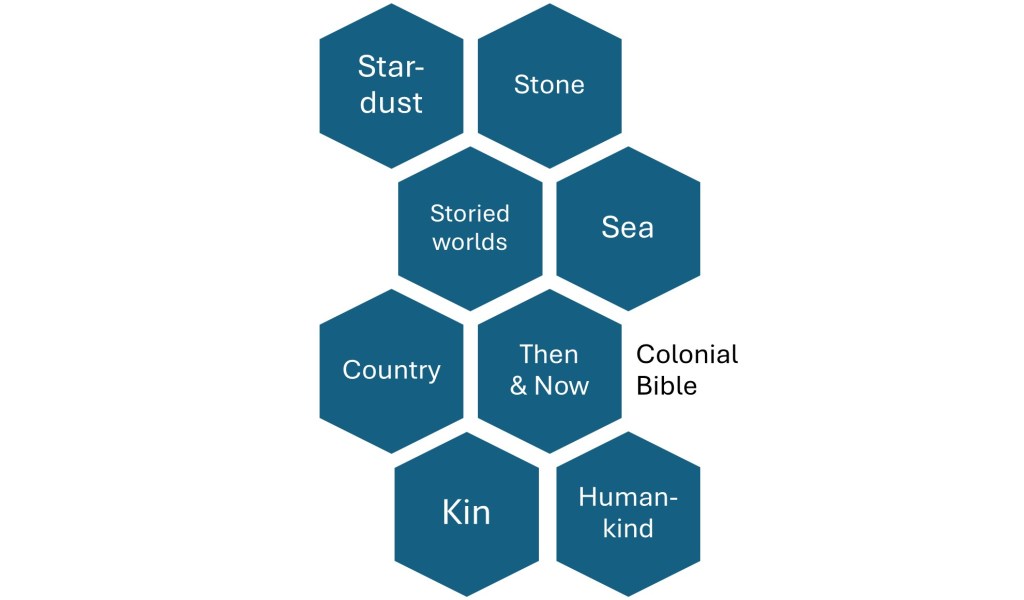
If linear thinking of deep time is insufficient, perhaps there is another way of imagining the connections. Might this honeycomb be another way of imaging deep pasts and deep futures and their contemporary presences.
What is the colonial Bible in this frame? Does it sit outside as a rupture? Yes, but …
It is already interconnected by its very materiality which is not something I oppose in my work to spirituality but talk instead of a material sacred. Spirit and matter deeply entwined, like the way calcium flows through caves, mountains, coral and the bones of humans and other animals.
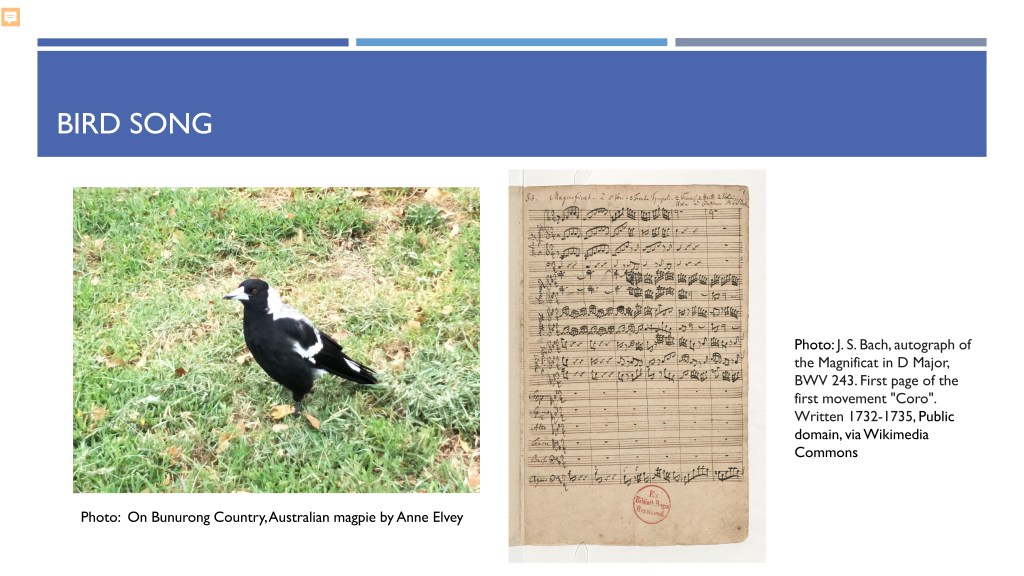
Another attempt I make to think across time is to set a song like Luke’s Magnificat in the context of the story of the emergence of bird song which Tim Low (2014)argues arose in this continent and spread across the globe (Elvey 2020). If human song learns from, echoes, responds to bird song, then the songs that have found their way into the Bible do not arrive disconnected from this place but circle back to the place of their singing avian ancestors.
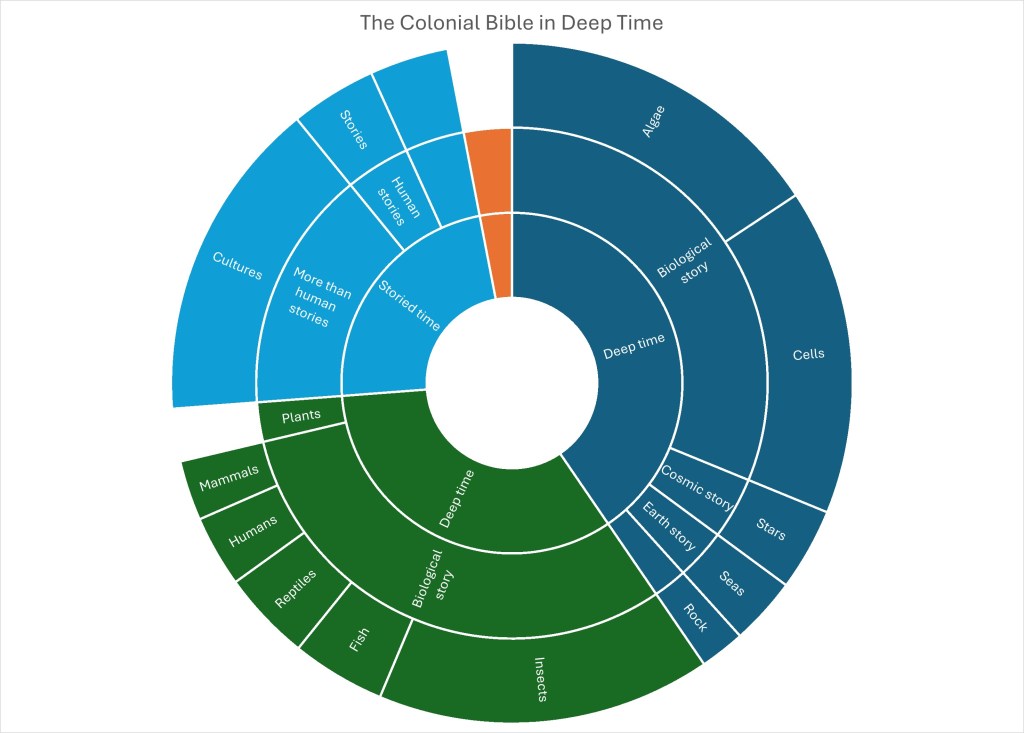
Might deep pasts and deep futures be portrayed as a kind of circle with layers of story, and the colonial Bible as part of this but also an intrusion?
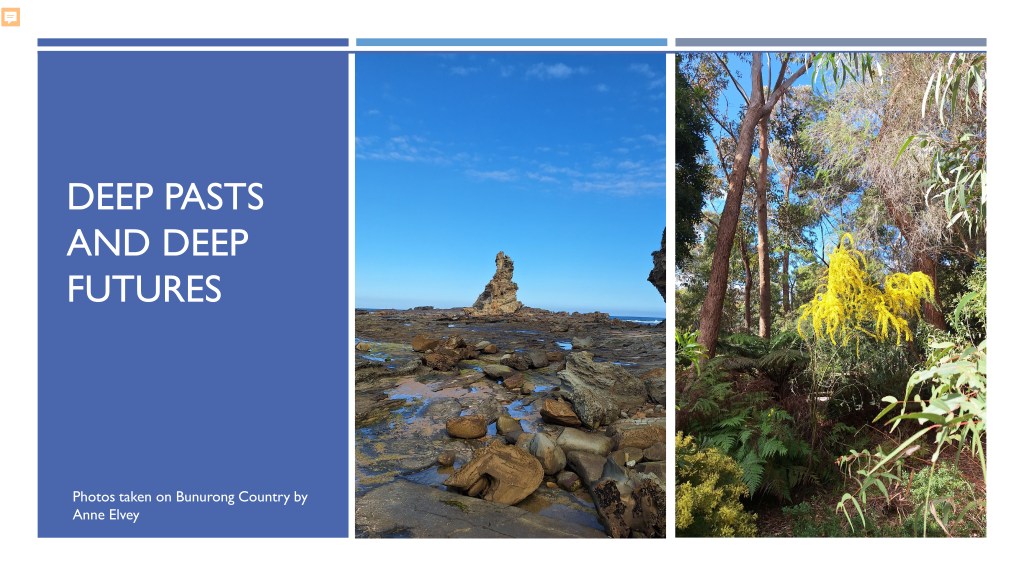
I want to close by reflecting that a deep future is already here in the effects of human actions through climate change and the responsibility this calls forth in us.
According to Tony Birch (2018)and others, this is also part of the colonising same, a colonial déjà vu, an ongoing trauma enacted on Earth, Country and First Peoples, where colonial invasion and ecological trauma intersect. I attempt to address this a little when I consider the signs of the time/season/period or kairos in Luke 12, where recognising the signs of the time – a kind of attentiveness to testimony / truth telling/ truth receiving – is crucial (Elvey 2023).
I hope this short reflection offers some openings for further conversation around colonial time, the Bible and time-space in its depths and breadths …
Anne Elvey
Works cited
Birch, Tony, 2018, ‘”We’ve Seen the End of the World and We Don’t Accept It”: Protection of Indigenous Country and Climate Justice’, in Places of Privilege: Interdisciplinary Perspectives on Identities, Change and Resistance (ed. Nicole Oke, Christopher Sonn and Alison Baker; Leiden: Brill), pp. 139-152
Elvey, Anne, 2020, ‘Deep Time: Mary’s Song and the Songs of Birds’, in Reading the Magnificat in Australia: Unsettling Engagements (Sheffield: Sheffield Phoenix Press), pp. 135-173
Elvey, Anne, 2023, Reading with Earth: Contributions of the New Materialism to an Ecological Feminist Hermeneutics (London: Bloomsbury T&T Clark), esp. chs. 6 & 10
Low, Tim, 2014, Where Song Began: Australia’s Birds and How They Changed the World (Melbourne: Penguin Viking)
Watego, Chelsea, 2021, Another Day in the Colony (St Lucia: UQP)
 Place is Presence: Time Country Bible
Leave a comment